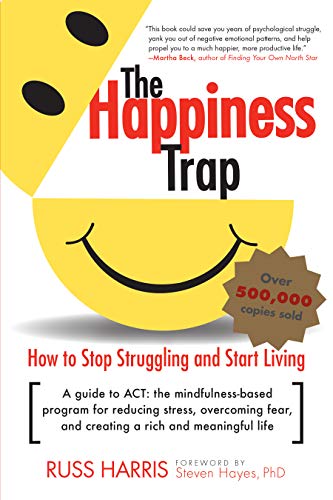
Readwise: The Happiness Trap

SUMMARY

The Happiness Trap reveals a paradox: trying to avoid negative feelings creates more suffering. Through Acceptance and Commitment Therapy (ACT), the book teaches psychological flexibility accepting difficult thoughts and feelings, defusing from unhelpful mental stories, and taking action guided by values rather than pursuing happiness itself.

Main Points

The Happiness Trap Paradox

So here is the happiness trap in a nutshell: to find happiness, we try to avoid or get rid of bad feelings, but the harder we try, the more bad feelings we create. (539) - From The Happiness Trap

The core problem: our attempts to avoid or eliminate negative feelings actually create more suffering. The harder we try to escape bad feelings, the more trapped we become in pursuing happiness.

Psychological Flexibility

Psychological flexibility is the ability to adapt to a situation with awareness, openness, and focus and to take effective action, guided by your values. (636) - From The Happiness Trap

The foundation of ACT (Acceptance and Commitment Therapy) that involves two major components: (1) adapting with openness, awareness, and focus, and (2) taking effective action guided by values.

The Nature of Inner Experience

Thoughts = words inside our heads
Images = pictures inside our heads
Sensations = feelings inside our bodies. (682) - From The Happiness Trap

This framework helps us observe and work with our inner experiences by understanding the three components of our internal world.

Cognitive Defusion

In ACT, our main interest in a thought is not whether it’s true or false, but whether it’s helpful; that is, if we pay attention to this thought, will it help us create the life we want? (691) - From The Happiness Trap

All too often we react to our thoughts as if they are the absolute truth or as if we must give them all our attention. The psychological jargon for this reaction is “fusion.” (705) - From The Happiness Trap

The practice of stepping back from thoughts rather than treating them as absolute truth. We evaluate thoughts based on whether they’re helpful rather than whether they’re true or false.

Working with Stories

Once you’ve acknowledged a story, that’s it—just let it be. You don’t have to challenge it or push it away, nor do you have to give it much attention. Simply let it come and go as it pleases, while you channel your energy into doing something you value. (797) - From The Happiness Trap

Anytime you’re feeling stressed, anxious, or depressed, ask yourself, “What story is my mind telling me now?” Then once you’ve identified it, defuse it. (809) - From The Happiness Trap

When experiencing difficult emotions, identify the story your mind is telling you, then defuse from it. Simply acknowledge the story and channel your energy into valued action instead.

The Thinking Self vs. The Observing Self

The thinking self is responsible for thinking, in the broadest sense of the word; it produces all our thoughts, judgments, images, fantasies, and memories, and it is commonly called “the mind.” The observing self is responsible for awareness, attention, and focus. It can observe thoughts, images, memories, etc., but it cannot produce them. It has no commonly used word to describe it. (1633) - From The Happiness Trap

You can think of the observing self as being like the sky, while thoughts and feelings are like the weather—constantly changing. (2604) - From The Happiness Trap

Two aspects of consciousness: the thinking self (the “mind”) produces all mental content, while the observing self is responsible for awareness and can observe but not produce thoughts.

Expansion: The Four Steps

The four basic steps of expansion are: observe your feelings, breathe into them, make room for them, and allow them to be there. (1679) - From The Happiness Trap

A technique for relating to difficult feelings as an alternative to struggling against uncomfortable emotions.

The ACT Formula

A = Accept your thoughts and feelings. C = Connect with your values. T = Take effective action. (1940) - From The Happiness Trap

This simple framework summarizes the core approach of ACT for building psychological flexibility.

Values as Direction

A value is a direction we desire to keep moving in, an ongoing process that never reaches an end. (2688) - From The Happiness Trap

As the great philosopher Friedrich Nietzsche once said, “He who has a why to live for, can bear almost any how.” (2711) - From The Happiness Trap

Values are not goals to achieve but directions we desire to keep moving in an ongoing process that never reaches an end. They provide meaning and guide our actions even in difficult circumstances.

Freedom in Choosing Your Attitude

We who lived in concentration camps can remember the men who walked through the huts comforting others, giving away their last piece of bread. They may have been few in number, but they offer sufficient proof that everything can be taken from a man but one thing: the last of human freedoms—to choose one’s attitude in any given set of circumstances, to choose one’s own way. (2735) - From The Happiness Trap

Drawing from Viktor Frankl’s experience in concentration camps: everything can be taken from a person except the last of human freedoms to choose one’s attitude in any given set of circumstances. This represents the ultimate human freedom.

Reframing Success and Failure

Sir Winston Churchill: “Success is not final. Failure is not fatal. It is the courage to continue that counts.” (3474) - From The Happiness Trap

As Winston Churchill put it: “A pessimist sees the difficulty in every opportunity; an optimist sees the opportunity in every difficulty.” (3541) - From The Happiness Trap

Success is not final, and failure is not fatal ñ€” what counts is the courage to continue. Our perspective shapes our experience and resilience.

The FEAR Acronym

you’ve probably come up against one or more components of FEAR: Fusion. Excessive expectations. Avoidance of discomfort. Remoteness from values. (3601) - From The Happiness Trap

Common obstacles to valued action:

  • Fusion (with thoughts)
  • Excessive expectations
  • Avoidance of discomfort
  • Remoteness from values

Recognizing these barriers helps us move past them toward meaningful action.