Auto Generated via Readwise
These are my highlights created/synced via Readwise.io - Referral Link
About
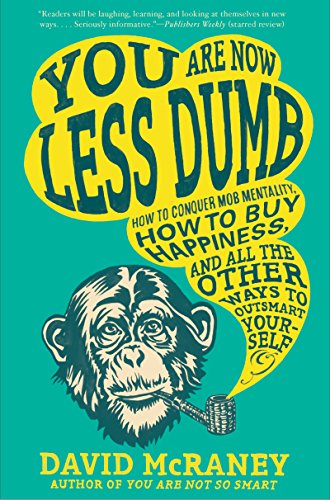
Title: You Are Now Less Dumb
Authors: David McRaney
Category:books
Number of Highlights: 21
Date: 2026-03-14
Last Highlighted: 2026-03-14
Highlights
It’s always true that whenever you look at the human condition and get a case of the smugs, a nice heaping helping of ridiculousness plops in your lap and remedies the matter. (86)
Psychologists Albert Hastorf at Dartmouth and Hadley Cantril at Princeton noticed soon after the game the college newspapers of each school began printing stories that seemed to suggest two versions of the truth were in open competition to become the official version of reality. (103)
To paraphrase psychologist Daniel Gilbert, memory, perception, and imagination are representations not replicas. A memory is least accurate when most reflected upon, and most accurate when least pondered. (146)
Psychologists Dan Simons and Christopher Chabris published a study in 2011 revealing that 63 percent of those surveyed in the United States believe memory works like a video camera, and another 48 percent believe memories are permanent. An additional 37 percent said that eyewitness testimony was reliable enough to be the only evidence necessary to convict someone accused of a crime. (148)
The moment your first kiss was over, the memory of it began to decay. Each time you recall it, the event is reformed in your mind anew and differently, influenced by your current condition and by all the wisdom you’ve acquired since and all the erroneous details you’ve added. (153)
Note: This is why trauma get worse
Complicated and confusing questions morph into gut checks, and gut checks are often unreliable. When you use heuristics, you tend to believe you’ve been rationally contemplating your existence, when in reality you just took a shortcut and never looked back. (201)
That tilted view is translated into incomplete, inaccurate memories that degrade with each recall. The glue of narrative—the innate human skill for storytelling—holds the whole misinformed hodgepodge together. Your ability to tell stories keeps you sane and stable, even if those stories can be pretty far from the truth. (229)
Narrative Bias THE MISCONCEPTION: You make sense of life through rational contemplation. THE TRUTH: You make sense of life through narrative. (265)
Rokeach wrote, “The three Christs were, if not rational men, at least men of a type we had all encountered before; they were rationalizing men.” (314)
This is partially explained by the conjunction fallacy. Your narrative bias is bolstered when you are presented with an abundance of information. The more info you get about a statement, the more likely you are to believe that statement. (370)
As they go in and out of this state, they often report visions, hallucinations of the fantastic and the everyday, like dreams. James Whinnery, a medical doctor for the air force, has studied hundreds of these blackouts over the last thirty years, videotaping them and comparing their nuances, interviewing the pilots and recording their reports. Over time, he has found striking similarities to the same sorts of things reported by patients who lost consciousness on operating tables, in car crashes, and after returning from other nonbreathing states. The tunnel, the white light, friends and family coming to greet you, memories zooming around—the pilots experienced all this. In addition, the centrifuge was pretty good at creating out-of-body experiences. Pilots would float over themselves, or hover nearby, looking on as their heads lurched and waggled about. As Whinnery and other researchers have speculated, the near-death and out-of-body phenomena are both actually the subjective experience of a brain owner watching as his brain tries desperately to figure out what is happening and to orient itself amid its systems going haywire due to oxygen deprivation. (403)
Even as the brain is dying, it refuses to stop generating a narrative, the scaffolding upon which it weaves cause and effect, memory and experience, feeling and cognition. Narrative is so important to survival that it is literally the last thing you give up before becoming a sack of meat. (413)
Psychologists call these false accounts confabulations—unintentional lies. Confabulations aren’t true, but the person making the claims doesn’t realize it. Neuroscience now knows that confabulations are common and continuous in both the healthy and the afflicted, but in the case of Cotard’s delusion, they are magnified to grotesque proportions. The same narrative bias driving your explanations is what causes confabulation among those with serious physical damage to the brain. (449)
confused mind gets unconfused very quickly. When things seem weird and nonsensical, the brain makes them make sense immediately. Disorientation gets orientated, even if that means temporarily believing in something that is several time zones away from being the truth. (463)
According to psychologist Dan McAdams, when your attempts at narrative fail you, that’s when you free-fall into malaise and ennui, anomie and stagnation. This, he suggests, is why people lose themselves after retirement. Without a narrative binding, their wants, needs, and goals fall apart. McAdams is one of the pioneers of narrative psychology, and across several books he describes the predictable process of personal myth formation and the universal nature of mythology. Storytelling, he writes, appears in every human culture. According to McAdams, meaning is more important than happiness, and “to make meaning is to create dynamic narratives that render sensible and coherent the seeming chaos of human existence.” (534)
If you look back on a behavior, thought, or emotion and feel befuddled, you experience an intense desire to explain it, and that explanation can affect your future behavior, your future thoughts, your future feelings. The most common way you do this is through something termed a post hoc rationalization. A post hoc rationalization is an explanation after the fact that makes enough sense to you that you can move on and not get stalled second-guessing your own motivation. (560)
You might find it alarming, then, to learn that neuroscience and psychology have teamed up over the last twenty years and used their combined powers to reach a strange and unsettling conclusion: The self is not real. It’s just a story like all the others, one created by your narrative bias. (584)
Once you gain the ability to assume others have their own thoughts, the concept of other minds is so powerful that you project it into everything: plants, glitchy computers, boats with names, anything that makes more sense to you when you can assume, even jokingly, it has a sort of self. That sense of agency is so powerful that people throughout time have assumed a consciousness at the helm of the sun, the moon, the winds, and the seas. Out of that sense of self and other selves come the narratives that have kept whole societies together. The great mythologies of the ancients and moderns are stories made up to make sense of things on a grand scale. So strong is the narrative bias that people live and die for such stories and devote whole lives to them (as well as take lives for them). (607)
You don’t have access to the truth of what has happened, but that doesn’t stop you from coming up with a story to explain it. In that story, you mistake awareness for creation. In reality, the part of you that is aware is not the sole proprietor of your brain. To paraphrase psychologist George Miller, you don’t experience thinking; you experience the result of thinking. (623)
The Common Belief Fallacy THE MISCONCEPTION: The larger the consensus, the more likely it is correct. THE TRUTH: A belief is not more likely to be accurate just because many people share it. (654)
In Latin, it is argumentum ad populum, or “appeal to the people,” which should clue you in that this is something your species has worried about for a long time. (699)
Title: You Are Now Less Dumb
Author: David McRaney
Tags: TVZ, readwise, books
date: 2026-04-08
Highlights
- It’s always true that whenever you look at the human condition and get a case of the smugs, a nice heaping helping of ridiculousness plops in your lap and remedies the matter. (Location 86)
- Psychologists Albert Hastorf at Dartmouth and Hadley Cantril at Princeton noticed soon after the game the college newspapers of each school began printing stories that seemed to suggest two versions of the truth were in open competition to become the official version of reality. (Location 103)
- To paraphrase psychologist Daniel Gilbert, memory, perception, and imagination are representations not replicas. A memory is least accurate when most reflected upon, and most accurate when least pondered. (Location 146)
- Psychologists Dan Simons and Christopher Chabris published a study in 2011 revealing that 63 percent of those surveyed in the United States believe memory works like a video camera, and another 48 percent believe memories are permanent. An additional 37 percent said that eyewitness testimony was reliable enough to be the only evidence necessary to convict someone accused of a crime. (Location 148)
- The moment your first kiss was over, the memory of it began to decay. Each time you recall it, the event is reformed in your mind anew and differently, influenced by your current condition and by all the wisdom you’ve acquired since and all the erroneous details you’ve added. (Location 153)
- Note: This is why trauma get worse
- Complicated and confusing questions morph into gut checks, and gut checks are often unreliable. When you use heuristics, you tend to believe you’ve been rationally contemplating your existence, when in reality you just took a shortcut and never looked back. (Location 201)
- That tilted view is translated into incomplete, inaccurate memories that degrade with each recall. The glue of narrative—the innate human skill for storytelling—holds the whole misinformed hodgepodge together. Your ability to tell stories keeps you sane and stable, even if those stories can be pretty far from the truth. (Location 229)
- Narrative Bias THE MISCONCEPTION: You make sense of life through rational contemplation. THE TRUTH: You make sense of life through narrative. (Location 265)
- Rokeach wrote, “The three Christs were, if not rational men, at least men of a type we had all encountered before; they were rationalizing men.” (Location 314)
- This is partially explained by the conjunction fallacy. Your narrative bias is bolstered when you are presented with an abundance of information. The more info you get about a statement, the more likely you are to believe that statement. (Location 370)
- As they go in and out of this state, they often report visions, hallucinations of the fantastic and the everyday, like dreams. James Whinnery, a medical doctor for the air force, has studied hundreds of these blackouts over the last thirty years, videotaping them and comparing their nuances, interviewing the pilots and recording their reports. Over time, he has found striking similarities to the same sorts of things reported by patients who lost consciousness on operating tables, in car crashes, and after returning from other nonbreathing states. The tunnel, the white light, friends and family coming to greet you, memories zooming around—the pilots experienced all this. In addition, the centrifuge was pretty good at creating out-of-body experiences. Pilots would float over themselves, or hover nearby, looking on as their heads lurched and waggled about. As Whinnery and other researchers have speculated, the near-death and out-of-body phenomena are both actually the subjective experience of a brain owner watching as his brain tries desperately to figure out what is happening and to orient itself amid its systems going haywire due to oxygen deprivation. (Location 403)
- Even as the brain is dying, it refuses to stop generating a narrative, the scaffolding upon which it weaves cause and effect, memory and experience, feeling and cognition. Narrative is so important to survival that it is literally the last thing you give up before becoming a sack of meat. (Location 413)
- Psychologists call these false accounts confabulations—unintentional lies. Confabulations aren’t true, but the person making the claims doesn’t realize it. Neuroscience now knows that confabulations are common and continuous in both the healthy and the afflicted, but in the case of Cotard’s delusion, they are magnified to grotesque proportions. The same narrative bias driving your explanations is what causes confabulation among those with serious physical damage to the brain. (Location 449)
- confused mind gets unconfused very quickly. When things seem weird and nonsensical, the brain makes them make sense immediately. Disorientation gets orientated, even if that means temporarily believing in something that is several time zones away from being the truth. (Location 463)
- According to psychologist Dan McAdams, when your attempts at narrative fail you, that’s when you free-fall into malaise and ennui, anomie and stagnation. This, he suggests, is why people lose themselves after retirement. Without a narrative binding, their wants, needs, and goals fall apart. McAdams is one of the pioneers of narrative psychology, and across several books he describes the predictable process of personal myth formation and the universal nature of mythology. Storytelling, he writes, appears in every human culture. According to McAdams, meaning is more important than happiness, and “to make meaning is to create dynamic narratives that render sensible and coherent the seeming chaos of human existence.” (Location 534)
- If you look back on a behavior, thought, or emotion and feel befuddled, you experience an intense desire to explain it, and that explanation can affect your future behavior, your future thoughts, your future feelings. The most common way you do this is through something termed a post hoc rationalization. A post hoc rationalization is an explanation after the fact that makes enough sense to you that you can move on and not get stalled second-guessing your own motivation. (Location 560)
- You might find it alarming, then, to learn that neuroscience and psychology have teamed up over the last twenty years and used their combined powers to reach a strange and unsettling conclusion: The self is not real. It’s just a story like all the others, one created by your narrative bias. (Location 584)
- Once you gain the ability to assume others have their own thoughts, the concept of other minds is so powerful that you project it into everything: plants, glitchy computers, boats with names, anything that makes more sense to you when you can assume, even jokingly, it has a sort of self. That sense of agency is so powerful that people throughout time have assumed a consciousness at the helm of the sun, the moon, the winds, and the seas. Out of that sense of self and other selves come the narratives that have kept whole societies together. The great mythologies of the ancients and moderns are stories made up to make sense of things on a grand scale. So strong is the narrative bias that people live and die for such stories and devote whole lives to them (as well as take lives for them). (Location 607)
- You don’t have access to the truth of what has happened, but that doesn’t stop you from coming up with a story to explain it. In that story, you mistake awareness for creation. In reality, the part of you that is aware is not the sole proprietor of your brain. To paraphrase psychologist George Miller, you don’t experience thinking; you experience the result of thinking. (Location 623)
- The Common Belief Fallacy THE MISCONCEPTION: The larger the consensus, the more likely it is correct. THE TRUTH: A belief is not more likely to be accurate just because many people share it. (Location 654)
- In Latin, it is argumentum ad populum, or “appeal to the people,” which should clue you in that this is something your species has worried about for a long time. (Location 699)